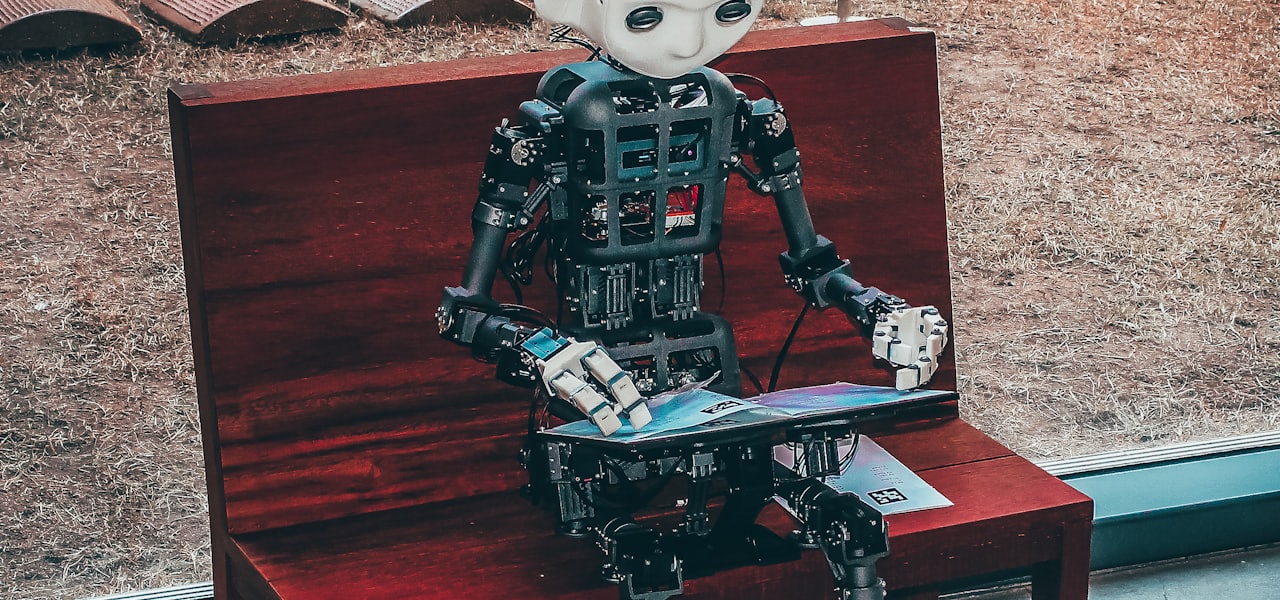
Objective Vision (Object Oriented Visionary) is a project mainly aimed at real-time computer vision and simulation vision of living creatures. it has three sections containing an open-source library of programming functions for using inside the projects, Virtual laboratory for scholars to check the application of functions directly and by command-line code for external and instant access, and the research section consists of paperwork and libraries to expand the scientific prove of works. == Background == The process has been used in the OVC libraries is as same as what's happening when living see a picture, and it's designed to give the researchers to experience the brain's visual cortex most close simulation for picture perception. The OVC was designed to work as a simulated visual cortex that has a critical job in processing and classify the objects to make it easier to work with pictures and graphical perception and processing. The human brain is much more aware of how it solves complex problems such as playing chess or solving algebra equations, which is why computer programmers have had so much success building machines that emulate this type of activity. but when the whole process is still a riddle that how the entities visionary system works. The project was simulated the visionary system by how it starts to convert the signals to image(actually the edges and colors) and then recognizing the shapes to find a relation between brain's information and image. The Objective Visionary system actually is concentrating on the separable sections, this separation gives the application visionary system the excellence processing result, because with this method the system do not waste much time on processing non significant sections and signals. this operation in the Objective Vision project called objective processing and because the O.V. mission is focused on human visionary simulation, so the developer refers with Objective Vision. == History == Objective-Vision is a Human (Natural) Visionary simulation Project developed by Michael Bidollahkhany. Following an explosion of interest during the 21st century were characterized by the maturing of the field and the significant growth of active applications; simulation of visionary systems, visionary based autonomous vehicle guidance, medical imaging (2D and 3D) and automatic surveillance are the most rapidly developing areas. This progress can be seen in an increasing number of software and hardware products on the market, as well as in a number of digital image processing software and APIs and also machine vision courses offered at universities worldwide. Therefore, the OVC project has been released as a research software project in 2016. One of important parts of this project was O.V.C. (Objective Vision Class library), that was designed to able companies and scientists to use the brain's most likely functionalities as visionary libraries to simplify and accelerate the image processing algorithms developments. The project started under MIT copyright license, but since 2018 the project continued as classified based on sponsors opinion. == The Algorithm == As developers claimed the algorithm used in the class library and developer's kit of project has been developed based on natural visionary system, and the functionalities containing image processing, optimization and labeling etc. are mostly upgraded and near techniques. Suppose that we've a picture of a jungle, or somewhere else, with this library developer will be able to manipulate not only the pixel of images for data extraction, but automatically based on which algorithm is used and image quality, he can manipulate directly a list of objects, same pixels and every data project needs to have, said the developer in his lecture answering how the algorithm works. === Viewpoint === For long times digital image processing and storing, was actually by processing just pixels; this Project tries to present a new kind of image processing and even storing, "objective vision" or "object-oriented visionary" is called. This project officially launched in May 2016, with the aim of making more adaptation between Computer Vision (Include Visionary, Digital image processing, discernment and even Perception) and Human Visual System; about development of the project: "...so we decided to research on Human Vision System, besides we worked on Artificial Retinal image processing and new visionary optimization unit(Presented at Istanbul Technical University Conference(Turkey 2015-2016)) and grew our research to Visionary CORTEX of Brain", Michael Bidollahkhany said. == Applications == The OVC application areas include: 2D and 3D feature toolkits Egomotion estimation Human–computer interaction (HCI) Mobile robotics Motion understanding Object identification Segmentation and recognition Stereopsis stereo vision: depth perception from two cameras Structure from motion (SFM) Motion tracking == Programming language == In first initial release of Objective Visionary Project the algorithm has been written in C++ and C#, and the virtual laboratory has been developed in C# and Delphi. Based on developers last lecture since the second release the complete algorithm has been re-written in C# based on .Net Core 1.0 to make it easier to work on different operating systems.
Wide-column store
A wide-column store (or extensible record store) is a type of NoSQL database. It uses tables, rows, and columns, but unlike a relational database, the names and format of the columns can vary from row to row in the same table. A wide-column store can be interpreted as a two-dimensional key–value store. Google's Bigtable is one of the prototypical examples of a wide-column store. == Wide-column stores versus columnar databases == Wide-column stores such as Bigtable and Apache Cassandra are not column stores in the original sense of the term, since their two-level structures do not use a columnar data layout. In genuine column stores, a columnar data layout is adopted such that each column is stored separately on disk. Wide-column stores do often support the notion of column families that are stored separately. However, each such column family typically contains multiple columns that are used together, similar to traditional relational database tables. Within a given column family, all data is stored in a row-by-row fashion, such that the columns for a given row are stored together, rather than each column being stored separately. Wide-column stores that support column families are also known as column family databases. == Notable examples == Notable wide-column stores include: Apache Accumulo Apache Cassandra Apache HBase Bigtable DataStax Enterprise (uses Apache Cassandra) DataStax Astra DB (uses Apache Cassandra) Hypertable Azure Tables ScyllaDB
Supervisor Mode Access Prevention
Supervisor Mode Access Prevention (SMAP) is a feature of some CPU implementations such as the Intel Broadwell microarchitecture that allows supervisor mode programs to optionally set user-space memory mappings so that access to those mappings from supervisor mode will cause a trap. This makes it harder for malicious programs to "trick" the kernel into using instructions or data from a user-space program. == History == Supervisor Mode Access Prevention is designed to complement Supervisor Mode Execution Prevention (SMEP), which was introduced earlier. SMEP can be used to prevent supervisor mode from unintentionally executing user-space code. SMAP extends this protection to reads and writes. == Benefits == Without Supervisor Mode Access Prevention, supervisor code usually has full read and write access to user-space memory mappings (or has the ability to obtain full access). This has led to the development of several security exploits, including privilege escalation exploits, which operate by causing the kernel to access user-space memory when it did not intend to. Operating systems can block these exploits by using SMAP to force unintended user-space memory accesses to trigger page faults. Additionally, SMAP can expose flawed kernel code which does not follow the intended procedures for accessing user-space memory. However, the use of SMAP in an operating system may lead to a larger kernel size and slower user-space memory accesses from supervisor code, because SMAP must be temporarily disabled any time supervisor code intends to access user-space memory. == Technical details == Processors indicate support for Supervisor Mode Access Prevention through the Extended Features CPUID leaf. SMAP is enabled when memory paging is active and the SMAP bit in the CR4 control register is set. SMAP can be temporarily disabled for explicit memory accesses by setting the EFLAGS.AC (Alignment Check) flag. The stac (Set AC Flag) and clac (Clear AC Flag) instructions can be used to easily set or clear the flag. When the SMAP bit in CR4 is set, explicit memory reads and writes to user-mode pages performed by code running with a privilege level less than 3 will always result in a page fault if the EFLAGS.AC flag is not set. Implicit reads and writes (such as those made to descriptor tables) to user-mode pages will always trigger a page fault if SMAP is enabled, regardless of the value of EFLAGS.AC. == Operating system support == Linux kernel support for Supervisor Mode Access Prevention was implemented by H. Peter Anvin. It was merged into the mainline Linux 3.7 kernel (released December 2012) and it is enabled by default for processors which support the feature. FreeBSD has supported Supervisor Mode Execution Prevention since 2012 and Supervisor Mode Access Prevention since 2018. OpenBSD has supported Supervisor Mode Access Prevention and the related Supervisor Mode Execution Prevention since 2012, with OpenBSD 5.3 being the first release with support for the feature enabled. NetBSD support for Supervisor Mode Execution Prevention (SMEP) was implemented by Maxime Villard in December 2015. Support for Supervisor Mode Access Prevention (SMAP) was also implemented by Maxime Villard, in August 2017. NetBSD 8.0 was the first release with both features supported and enabled. Haiku support for Supervisor Mode Execution Prevention (SMEP) was implemented by Jérôme Duval in January 2018. macOS has support for SMAP at least since macOS 10.13 released 2017.
Shader lamps
Shader lamps is a computer graphic technique used to change the appearance of physical objects. The still or moving objects are illuminated, using one or more video projectors, by static or animated texture or video stream. The method was invented at University of North Carolina at Chapel Hill by Ramesh Raskar, Greg Welch, Kok-lim Low and Deepak Bandyopadhyay in 1999 [1] as a follow on to Spatial Augmented Reality [2] also invented at University of North Carolina at Chapel Hill in 1998 by Ramesh Raskar, Greg Welch and Henry Fuchs. A 3D graphic rendering software is typically used to compute the deformation caused by the non perpendicular, non-planar or even complex projection surface. Complex objects (or aggregation of multiple simple objects) create self shadows that must be compensated by using several projectors. The objects are typically replaced by neutral color ones, the projection giving all its visual properties, thus the name shader lamps. The technique can be used to create a sense of invisibility, by rendering transparency. The object is illuminated not by a replacement of its own visual properties, but by the corresponding visual surface placed behind the object as seen from an arbitrary viewing point.
Nagarik App
Nagarik App (translation: Citizen App) is a mobile application launched by the Government of Nepal to provide government-related services in a single online platform. The app was developed to facilitate an easier, systematic, and simplified delivery of government services to Nepali citizens digitally. The app was launched to play a pivotal role in revolutionizing the way citizens interact with the government. It offers government services through a single unified platform, minimizing the need for citizens to navigate multiple channels or physical offices for their diverse needs of government services. The services are added gradually according to the needs and services required. The government aims to reduce the physical queues and the need to be physically present to get services from the different government offices. One can get services online round-the-clock even during holidays. As of now, 25 services are included in the app, ranging from Police Clearance Report to Voters Card. The app contains and provides a vast range of government services. The app was launched on the occasion of the fourth National Information and Communication Technology Day, 2021 (2078 BS). The event marked a significant milestone in Nepal’s digital transformation journey. It aims to reduce all the bureaucratic hurdles that the citizens have been facing and make government services more efficient and convenient. In Oct 20, 2024, a E-Chalan was introduced for managing traffic violations in initially piloting in Kathmandu Valley. The Kathmandu Valley Traffic Police Office announced that physical licenses would no longer be confiscated for traffic rule violations. Instead, a "Digital Chit (E-Chalan)" system was implemented, allowing drivers to pay fines electronically. Integrated with the NagarikApp, the system enables police to access drivers' licenses, record violations, and update details directly in the app. == Features and Services == Inland Revenue Department (Nepal) PAN Registration Election Commission (Nepal) Voter Card Pre-Registration and Details Nepal Police Online Clearance Report Traffic Violations and Fine Payment Nepal Passport, Driving License, National Identity Card (NID), Citizenship, and Voter ID link details My Municipality (Includes contact info of the representatives, services such as ambulance, nearby police, and budget programs and plans) The Government Press ID card PF/PAN/SST/CIT statements can be viewed Nagarik Pahichan Dwar (Online bank accounts can be opened and KYC can be verified for selected banks using the QR) == Awards and honors == Each year, World Summit Award honors outstanding digital applications and solutions across various categories. The winners of the World Summit Award represent the pinnacle of innovation in their respective categories. Nagarik App was selected among 180 participants and won the World Summit Award of 2022 in Government and Citizen Engagement category. == Latest Statistics & Usage Trends (2082 BS / 2025 AD) == As of August 2025, over 1.5 million Nepali citizens have registered and actively use the Nagarik App, according to the National Information Technology Center (NITC). The majority of daily logins come from: Kathmandu Valley – 37% of total users Province 1 (Koshi) – 19% of total users Bagmati Province – 15% of total users On average, 45,000+ transactions (service requests, document verifications, and payments) are processed through the app each day. The most-used services include: PAN Card Registration – 28% of total requests Police Clearance Report – 22% Driving License Linking & E-Chalan Payment – 18% Vehicle Tax Payment – 14% Source: Internal report from NITC, July 2025 == Step-by-Step: How to Link Your Driving License with Nagarik App == Update the App – Install the latest version from Play Store or App Store. Login or Register – Ensure your SIM is registered in your own name. Go to “Transport Services” in the menu. Select “Driving License” – Enter your license number and date of birth. Verify via OTP – Sent to your registered mobile number. Confirmation – Your digital license will appear inside the app. This guide is continuously updated to reflect the latest rules from the Kathmandu Valley Traffic Police Office and changes in NITC’s backend system. For in-depth details, step-by-step tutorials, and the most recent Nagarik App updates, visit the full article on The Bipin Blog.
Glossary of computer graphics
This is a glossary of terms relating to computer graphics. For more general computer hardware terms, see glossary of computer hardware terms. == 0–9 == 2D convolution Operation that applies linear filtering to image with a given two-dimensional kernel, able to achieve e.g. edge detection, blurring, etc. 2D image 2D texture map A texture map with two dimensions, typically indexed by UV coordinates. 2D vector A two-dimensional vector, a common data type in rasterization algorithms, 2D computer graphics, graphical user interface libraries. 2.5D Also pseudo 3D. Rendering whose result looks 3D while actually not being 3D or having great limitations, e.g. in camera degrees of freedom. 3D graphics pipeline A graphics pipeline taking 3D models and producing a 2D bitmap image result. 3D paint tool A 3D graphics application for digital painting of multiple texture map image channels directly onto a rotated 3D model, such as zbrush or mudbox, also sometimes able to modify vertex attributes. 3D scene A collection of 3D models and lightsources in world space, into which a camera may be placed, describing a scene for 3D rendering. 3D unit vector A unit vector in 3D space. 4D vector A common datatype in graphics code, holding homogeneous coordinates or RGBA data, or simply a 3D vector with unused W to benefit from alignment, naturally handled by machines with 4-element SIMD registers. 4×4 matrix A matrix commonly used as a transformation of homogeneous coordinates in 3D graphics pipelines. 7e3 format A packed pixel format supported by some graphics processing units (GPUs) where a single 32-bit word encodes three 10-bit floating-point color channels, each with seven bits of mantissa and three bits of exponent. == A == AABB Axis-aligned bounding box (sometimes called "axis oriented"), a bounding box stored in world coordinates; one of the simplest bounding volumes. Additive blending A compositing operation where d s t = d s t + s r c , {\displaystyle dst=dst+src,} without the use of an alpha channel, used for various effects. Also known as linear dodge in some applications. Affine texture mapping Linear interpolation of texture coordinates in screen space without taking perspective into account, causing texture distortion. Aliasing Unwanted effect arising when sampling high-frequency signals, in computer graphics appearing e.g. when downscaling images. Antialiasing methods can prevent it. Alpha channel An additional image channel (e.g. extending an RGB image) or standalone channel controlling alpha blending. Ambient lighting An approximation to the light entering a region from a wide range of directions, used to avoid needing an exact solution to the rendering equation. Ambient occlusion (AO) Effect approximating, in an inexpensive way, one aspect of global illumination by taking into account how much ambient light is blocked by nearby geometry, adding visual clues about the shape. Analytic model A mathematical model for a phenomenon to be simulated, e.g. some approximation to surface shading. Contrasts with Empirical models based purely on recorded data. Anisotropic filtering Advanced texture filtering improving on mipmapping, preventing aliasing while reducing blur in textured polygons at oblique angles to the camera. Anti-aliasing Methods for filtering and sampling to avoid visual artifacts associated with the uniform pixel grid in 3D rendering. Array texture A form of texture map containing an array of 2D texture slices selectable by a 3rd 'W' texture coordinate; used to reduce state changes in 3D rendering. Augmented reality Computer-rendered content inserted into the user's view of the real world. AZDO Approaching zero driver overhead, a set of techniques aimed at reducing the CPU overhead in preparing and submitting rendering commands in the OpenGL pipeline. A compromise between the traditional GL API and other high-performance low-level rendering APIs. == B == Back-face culling Culling (discarding) of polygons that are facing backwards from the camera. Baking Performing an expensive calculation offline, and caching the results in a texture map or vertex attributes. Typically used for generating lightmaps, normal maps, or low level of detail models. Barycentric coordinates Three-element coordinates of a point inside a triangle. Beam tracing Modification of ray tracing which instead of lines uses pyramid-shaped beams to address some of the shortcomings of traditional ray tracing, such as aliasing. Bicubic interpolation Extension of cubic interpolation to 2D, commonly used when scaling textures. Bilinear interpolation Linear interpolation extended to 2D, commonly used when scaling textures. Binding Selecting a resource (texture, buffer, etc.) to be referenced by future commands. Billboard A textured rectangle that keeps itself oriented towards the camera, typically used e.g. for vegetation or particle effects. Binary space partitioning (BSP) A data structure that can be used to accelerate visibility determination, used e.g. in Doom engine. Bit depth The number of bits per pixel, sample, or texel in a bitmap image (holding one or more image channels, typical values being 4, 8, 16, 24, 32) Bitmap Image stored by pixels. Bit plane A format for bitmap images storing 1 bit per pixel in a contiguous 2D array; Several such parallel arrays combine to produce the a higher-bit-depth image. Opposite of packed-pixel format. Blend operation A render state controlling alpha blending, describing a formula for combining source and destination pixels. Bone Coordinate systems used to control surface deformation (via Weight maps) during skeletal animation. Typically stored in a hierarchy, controlled by key frames, and other procedural constraints. Bounding box One of the simplest type of bounding volume, consisting of axis-aligned or object-aligned extents. Bounding volume A mathematically simple volume, such as a sphere or a box, containing 3D objects, used to simplify and accelerate spatial tests (e.g. for visibility or collisions). BRDF Bidirectional reflectance distribution functions (BRDFs), empirical models defining 4D functions for surface shading indexed by a view vector and light vector relative to a surface. Bump mapping Technique similar to normal mapping that instead of normal maps uses so called bump maps (height maps). BVH Bounding volume hierarchy is a tree structure on a set of geometric objects. == C == Camera A virtual camera from which rendering is performed, also sometimes referred to as 'eye'. Camera space A space with the camera at the origin, aligned with the viewer's direction, after the application of the world transformation and view transformation. Cel shading Cartoon-like shading effect. Clipping Limiting specific operations to a specific region, usually the view frustum. Clipping plane A plane used to clip rendering primitives in a graphics pipeline. These may define the view frustum or be used for other effects. Clip space Coordinate space in which clipping is performed. Clip window A rectangular region in screen space, used during clipping. A clip window may be used to enclose a region around a portal in portal rendering. CLUT A table of RGB color values to be indexed by a lower-bit-depth image (typically 4–8 bits), a form of vector quantization. Color bleeding Unwanted effect in texture mapping. A color from a border of unmapped region of the texture may appear (bleed) in the mapped result due to interpolation. Color channels The set of channels in a bitmap image representing the visible color components, i.e. distinct from the alpha channel or other information. Color resolution Command buffer A region of memory holding a set of instructions for a graphics processing unit for rendering a scene or portion of a scene. These may be generated manually in bare metal programming, or managed by low level rendering APIs, or handled internally by high level rendering APIs. Command list A group of rendering commands ready for submission to a graphics processing unit, see also Command buffer. Compute API An API for efficiently processing large amounts of data. Compute shader A compute kernel managed by a rendering API, with easy access to rendering resources. Cone tracing Modification of ray tracing which instead of lines uses cones as rays in order to achieve e.g. antialiasing or soft shadows. Connectivity information Indices defining [rendering primitive]s between vertices, possibly held in index buffers. describes geometry as a graph or hypergraph. CSG Constructive solid geometry, a method for generating complex solid models from boolean operations combining simpler modelling primitives. Cube mapping A form of environment reflection mapping in which the environment is captured on a surface of a cube (cube map). Culling Before rendering begins, culling removes objects that don't significantly contribute to the rendered result (e.g. being obscured or outside camera view). == D == Decal A "sticker" picture applied onto a surface (e.g. a
CPU modes
CPU modes (also called processor modes, CPU states, CPU privilege levels and other names) are operating modes for the central processing unit of most computer architectures that place restrictions on the type and scope of operations that can be performed by instructions being executed by the CPU. For example, this design allows an operating system to run with more privileges than application software by running the operating systems and applications in different modes. Ideally, only highly trusted kernel code is allowed to execute in the unrestricted mode; everything else (including non-supervisory portions of the operating system) runs in a restricted mode and must use a system call (via interrupt) to request the kernel perform on its behalf any operation that could damage or compromise the system, making it impossible for untrusted programs to alter or damage other programs (or the computing system itself). Device drivers are designed to be part of the kernel due to the need for frequent I/O access. Multiple modes can be implemented, e.g. allowing a hypervisor to run multiple operating system supervisors beneath it, which is the basic design of many virtual machine systems available today. == Mode types == The unrestricted mode is often called kernel mode, but many other designations exist (master mode, supervisor mode, privileged mode, etc.). Restricted modes are usually referred to as user modes, but are also known by many other names (slave mode, problem state, etc.). Hypervisor Hypervisor mode is used to support virtualization, allowing the simultaneous operation of multiple operating systems. Kernel and user In kernel mode, the CPU may perform any operation allowed by its architecture; any instruction may be executed, any I/O operation initiated, any area of memory accessed, and so on. In the other CPU modes, certain restrictions on CPU operations are enforced by the hardware. Typically, certain instructions are not permitted (especially those—including I/O operations—that could alter the global state of the machine), some memory areas cannot be accessed, etc. User-mode capabilities of the CPU are typically a subset of those available in kernel mode, but in some cases, such as hardware emulation of non-native architectures, they may be significantly different from those available in standard kernel mode. Some CPU architectures support more modes than those, often with a hierarchy of privileges. These architectures are often said to have ring-based security, wherein the hierarchy of privileges resembles a set of concentric rings, with the kernel mode in the center. Multics hardware was the first significant implementation of ring security, but many other hardware platforms have been designed along similar lines, including the Intel 80286 protected mode, and the IA-64 as well, though it is referred to by a different name in these cases. Mode protection may extend to resources beyond the CPU hardware itself. Hardware registers track the current operating mode of the CPU, but additional virtual-memory registers, page-table entries, and other data may track mode identifiers for other resources. For example, a CPU may be operating in Ring 0 as indicated by a status word in the CPU itself, but every access to memory may additionally be validated against a separate ring number for the virtual-memory segment targeted by the access, and/or against a ring number for the physical page (if any) being targeted. This has been demonstrated with the PSP handheld system. Hardware that meets the Popek and Goldberg virtualization requirements makes writing software to efficiently support a virtual machine much simpler. Such a system can run software that "believes" it is running in supervisor mode, but is actually running in user mode. == Architectures == Several computer systems introduced in the 1960s, such as the IBM System/360, DEC PDP-6/PDP-10, the GE-600/Honeywell 6000 series, and the Burroughs B5000 series and B6500 series, support two CPU modes; a mode that grants full privileges to code running in that mode, and a mode that prevents direct access to input/output devices and some other hardware facilities to code running in that mode. The first mode is referred to by names such as supervisor state (System/360), executive mode (PDP-6/PDP-10), master mode (GE-600 series), control mode (B5000 series), and control state (B6500 series). The second mode is referred to by names such as problem state (System/360), user mode (PDP-6/PDP-10), slave mode (GE-600 series), and normal state (B6500 series); there are multiple non-control modes in the B5000 series. === RISC-V === RISC-V has three main CPU modes: User Mode (U), Supervisor Mode (S), and Machine Mode (M). Virtualization is supported via an orthogonal CSR setting instead of a fourth mode.